
PERT, CPM, Gantt. How did the Gantt chart become the defacto standard in representing a project schedule? In the realm of projects I have worked on, other than in academic settings, I’ve never contributed to or applied PERT/ CPM network diagrams in real life. That is not to say that we didn’t apply concepts of those methodologies in our planning and controls. Certainly, estimating, identifying task relationships, and critical paths are a core to project planning and control. But illustrating the project via a PERT or CPM diagram was not the method. That method was the Gantt chart. Why was that? What lead to the Gantt chart being the method / tool for illustrating a project’s schedule and status?
At the start of the 20th century, industrialization, manufacturing and supply chain complexities were combining with emerging management philosophies. Harry Gantt and Karol Adamiecki were promoting a waterfall bar-charting tool for manufacturing scheduling. This scheduling method did make its way from the production floor to project management, most notably in 1931 on the Hoover Dam project5.
By Mid-century, specific emphasis was focused on project planning, control and reporting. Questions were being asked about task relationships and validity of progress that Gantt wasn’t easily able to answer. The late 50’s produced CPM (Critical Path Method) and PERT (Program Evaluation Review Technique). These diagraming and control tools share many similarities and are often discussed together.
The Project Management Institute (PMI.ORG) has a nice oral history from the CPM creators (James E. Kelly, Morgan R. Walker, and John S. Sayer). In this recounting of CPM, corporate factors drove the need to better plan and execute factory turnaround at DuPont. There was enough executive sponsorship for them to demonstrate early concepts and apply them to a trial project. In this recounting of the CPM history, the team was given the task to improve scheduling related to design & construction of chemical plants, to reduce the cost and duration of those projects.
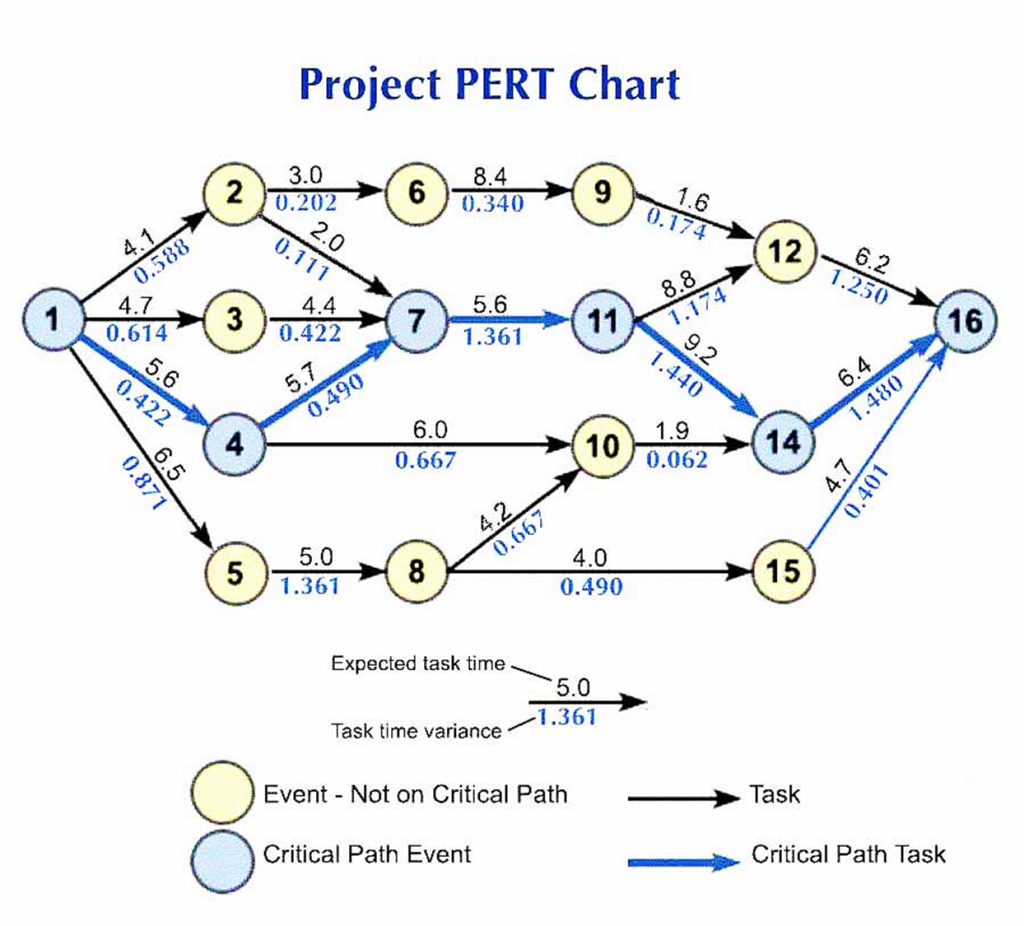
Somewhat simultaneously, the US Navy was attempting to answer similar questions around the Polaris Missile development program and so the Navy’s Office of Special Projects, enlisted the help of Booz-Allen Hamilton and Lockheed Corp to develop a method for assessing the validity of a schedule and reviewing the progress against that schedule to determine the probability of meeting the project objectives.
The complexities of managing multiple construction trades, factory layout, machine development, military subcontractors, multiple system designs was beyond what manual project management could manage. Let alone once a schedule was planned, and work started, changes inevitably began. And changes in a manual plan of thousands of lines required massive amounts of resources to update. That updating and maintaining could mean deadlines were missed before it was even known that a task was at risk.
Team CPM realized computers were the answer and their development started with computer support from the beginning2. Team PERT approaching from a different mathematical model also started with computer support in mind3. Thus began the efforts to illustrate a project’s tasks, durations and interdependencies in a way that allowed computational efficiency. These network diagrams evolved to make computer data entry easier, collect variables in a rational order and report out on those calculations. It was not necessarily the most intuitive way to illustrate the plan. As shown in the figure above, a casual observer would have difficulty interpreting a projects status.
That intuitive illustration had already been demonstrated by the Gantt chart. The largest example of Gantt chart use in project management was the Hoover Dam from 1931 to 19365. That was 20 years before CPM & PERT were to be developed! Since the turn of the 20th century the bar chart (Gantt Chart) was incorporated to aid manufacturing scheduling. It was easy to follow and to interact with. What it wasn’t good at was showing interdependencies, calculating critical path or capturing the logic behind the schedule. So, from a user perspective Gantt charts were great, from a maintenance and accuracy perspective they were lacking. And the gap wasn’t in the way the project was illustrated, it was in the way the project variables were captured and maintained. It could be done, but at great cost to speed and manpower.
PERT / CPM answered the gaps in what the Gantt chart couldn’t illustrate but it required specialized training and support to organize and feed data to the computer. The typical bar chart had to be deconstructed and important data and network relationships reorganized so punch cards could be created for loading into the UNIVAC computers. Project Planning teams were working for the computer to help make the computer work for them.
They were never going to rise because those methods catered to the computer’s requirements and not the users
The interesting point to here is that the development of PERT/ CPM was closely tied to the computational needs at the time. The need to feed the computer information in a way to support the mathematical models informed how the networks would look and work. In contrast Gantt charts were easy to build and understand but lacked the mathematical logic and successor/ predecessor dependencies that PERT / CPM did. As computer technology evolved; schedule, analysis and CPM management was absorbed into the Gantt chart method because that was more user friendly.
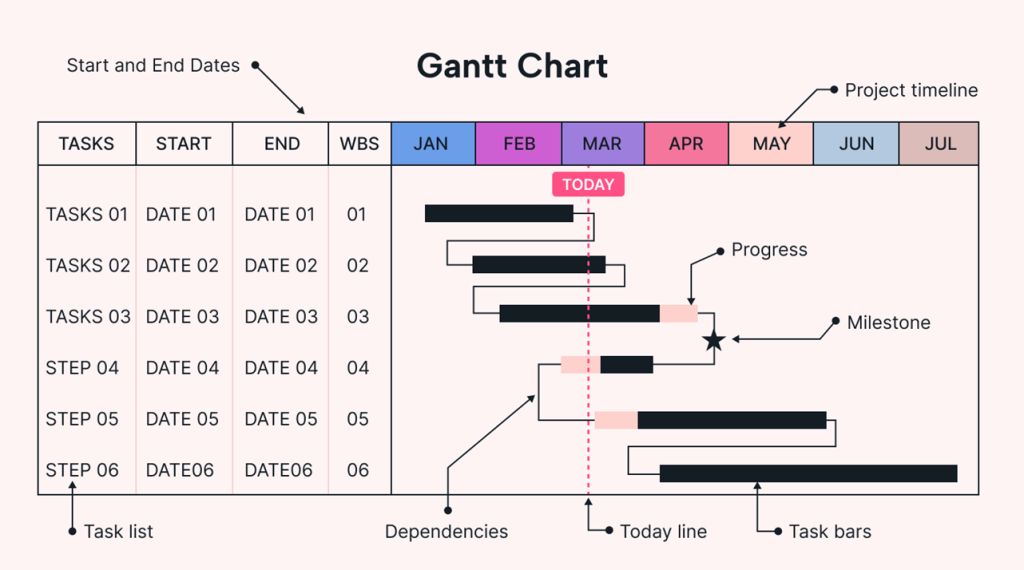
Today the PERT/ CPM math is embedded into and behind the Gantt chart user interface. We estimate, update, connect & disconnect dependencies all through Gantt chart interfaces. In a blink of an eye the network is updated, and the results are show in a clear schedule. A task turns red, it’s on the critical path. End milestones moved ,the impact is immediately visible. I think had computing technology been available at the onset of the Gantt chart, the PERT & CPM methods would have been applied directly to Gantt charts for project management.
There never was a rise and fall of PERT/ CPM. They were never going to rise because those methods catered to the computer’s requirements and not the users who needed to use the output of those calculations to manage their projects. The progress of computer technology and the incorporation of the complex math behind network scheduling democratized who could use these tools and for what projects4.
In my experience as a PM, being able to engage the team in the planning cycle in a way that is easy to understand and comprehensive pushes project ownership throughout the team. Similarly, being able to utilize the project management tools to report out and manage the critical dependencies frees time for the project manager to actually manage the project (remove barriers, identify constraints and support the teams responsible for the tasks).
References:
- Jack R. Meredith, Samual J. Mantel, “Project Management – A Managerial Approach- Second Edition”, Copyright: 1989 John Wiley & Sons, Inc.
- Project Management Institute, “Origins of CPM”, 1989, Origins of CPM – a Personal History | PMI
- Project Management Institute, “Some Reflections on PERT Project Management”, 1990, Some Reflections on PERT and Project Management | PMI
- Mosaics Projects, “A Brief History of Scheduling”, 2006 Microsoft Word – P042_History_of_Scheduing
- McNeil Engineering. “Project Management Lessons from the Hoover Dam.” , 2025, Project management lessons from the Hoover Dam: What engineers can learn from history – McNeil Engineering